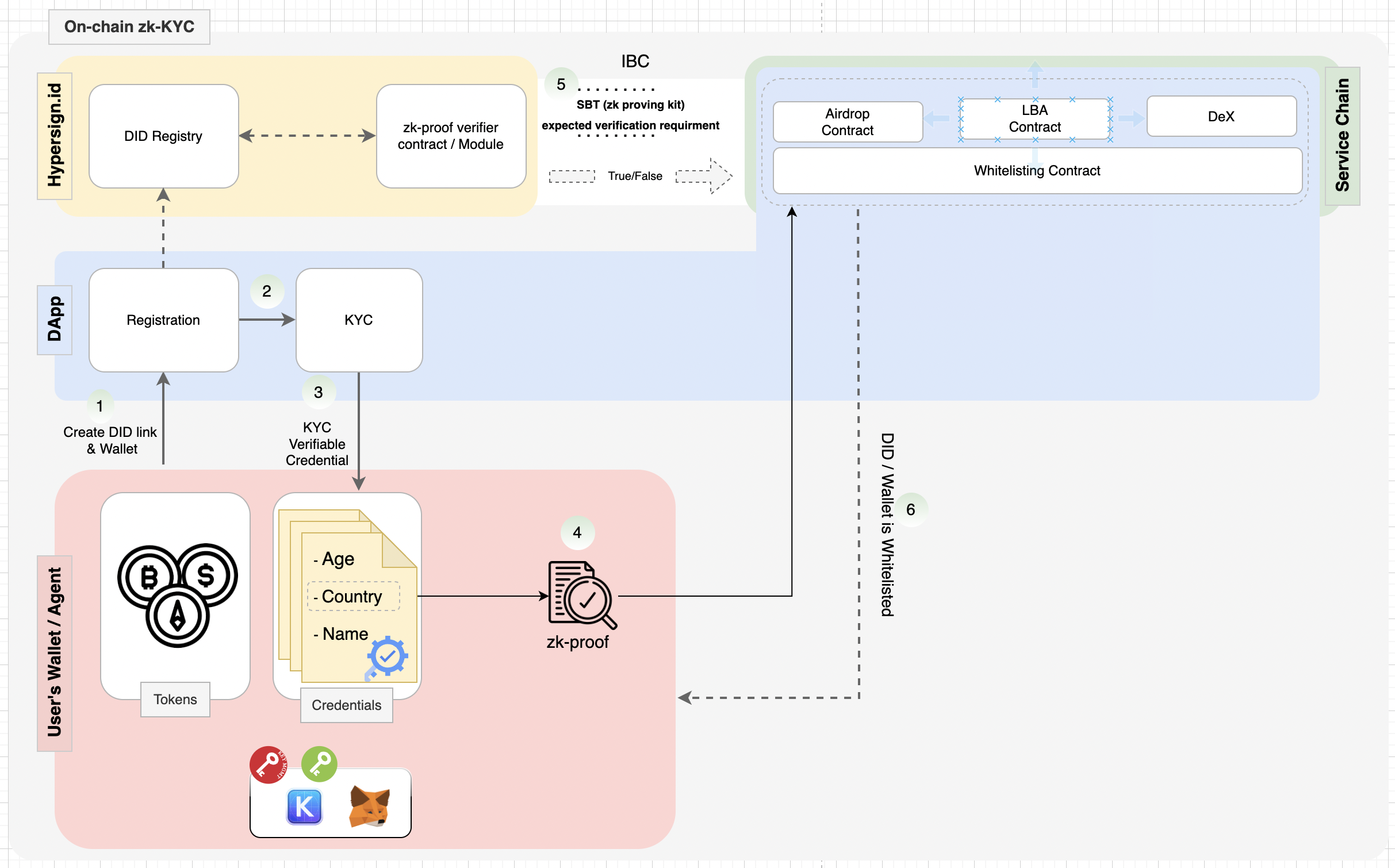
How ZK KYC preserves identity data
Traditional KYC workflows operate like a central vault: you hand over your passport, and the institution stores a copy. If that vault is breached, your identity is exposed. ZK KYC Systems change this dynamic by allowing applications to verify that a user meets compliance requirements without exposing or storing personal data. Instead of holding your documents, the system holds a cryptographic proof that you are who you say you are.
The core mechanism relies on zero-knowledge cryptography. When you submit your identity credentials to a trusted verifier, the system generates a zero-knowledge proof (ZKP). This proof is a mathematical statement that confirms specific attributes—such as "over 18" or "not on a sanctions list"—without revealing the underlying information. The verifying application only sees the proof, not your actual passport scan or birth date.
This approach establishes a privacy-compliance duality. You satisfy regulatory obligations, but the data minimization principle is strictly enforced. No sensitive PII is stored on the verifier’s servers, significantly reducing breach liability. As noted by Treza Labs, this infrastructure allows crypto and regulated finance applications to verify compliance status without the risk of holding raw personal data.
The result is a system where compliance is programmable. You can prove you are eligible to trade on a decentralized exchange without ever revealing your identity to the exchange itself. This separation of verification from data storage is what makes ZK KYC Systems guide a critical resource for modern fintech architecture.
On-chain verification flows in practice
ZK KYC Systems guide: The real value of zero-knowledge identity lies in how it bridges off-chain verification with on-chain trust. Instead of uploading sensitive personal data to a blockchain, the workflow splits into three distinct phases: identity verification, circuit generation, and on-chain proof validation. This separation ensures that smart contracts can confirm a user’s compliance status without ever seeing their underlying credentials.
Off-chain verification and credential issuance
The process begins with a trusted identity provider (IdP), such as a government agency or a regulated KYC firm. The user submits their documents—passport, selfie, or proof of address—to this provider. Once the IdP confirms the user’s identity, they issue a signed credential. This credential is typically stored in a decentralized identity wallet on the user’s device. At this stage, no data touches the blockchain; the user retains full custody of their identity proof.
Circuit generation and proof creation
Next, the user interacts with a zero-knowledge circuit. These circuits are pre-defined logic programs that specify exactly what data needs to be verified. For example, a circuit might ask: "Does the signed credential prove the user is over 18 and not on a sanctions list?" The user’s wallet runs the circuit locally, using their private credential as input. The circuit outputs a cryptographic proof—a compact, verifiable statement that confirms the condition is met without revealing the underlying data. This proof is often called a zk-SNARK or zk-STARK, depending on the cryptographic scheme used.
On-chain proof validation
Finally, the user submits the cryptographic proof to a smart contract on the blockchain. The contract contains a verification key that matches the circuit used to generate the proof. The smart contract checks the proof’s validity against this key. If the proof is valid, the contract emits an event or updates a state variable, effectively marking the user as "KYC verified." This on-chain state can then be used by DeFi protocols, DAOs, or other dApps to grant access to specific features, such as trading limits or governance voting rights.
This flow allows for modular integration. Service chains or application-specific blockchains can host their own verification contracts, while the underlying identity layer remains agnostic. This architecture supports scalability, as multiple dApps can reuse the same verification logic without duplicating efforts. The result is a privacy-preserving compliance layer that aligns with regulatory requirements while maintaining the decentralized ethos of Web3.
Comparing ZK KYC infrastructure providers
Selecting the right ZK KYC Systems guide partner depends on whether you prioritize raw verification speed, strict data minimization, or broad interoperability. The market has split into distinct camps: platforms built for high-throughput crypto exchanges, solutions focused on institutional compliance, and general-purpose identity layers.
Zyphe: Speed and Sub-Second Verification
Zyphe targets the high-frequency demands of crypto exchanges and DeFi protocols where latency matters. Their architecture emphasizes regulator-grade verification with sub-second performance. A key differentiator is their "no document retention" policy; they verify data in real-time without storing the underlying personal documents, reducing your liability surface. This makes them ideal for platforms that need to onboard thousands of users instantly without becoming a data honeypot for regulators.
Treza Labs: Enterprise-Grade Infrastructure
Trezalabs positions itself as the infrastructure layer for regulated finance. Their ZK-KYC solution is designed for applications that need to prove compliance without exposing user identity data. Treza focuses on the backend complexity, allowing fintechs to integrate privacy-preserving checks that satisfy traditional financial regulations. Their approach is less about consumer-facing speed and more about robust, auditable compliance trails that satisfy institutional risk teams.
zkPass: Reducing Redundancy Across Platforms
zkPass takes a different angle by tackling the inefficiency of repetitive KYC processes. Their documentation highlights how users currently repeat the same verification steps across multiple platforms, forcing enterprises to bear duplicated compliance costs. zkPass aims to create a reusable verification layer, allowing users to prove their status once and share it across different services. This is particularly useful for ecosystems where users interact with multiple dApps or platforms that share a common trust framework.
Galactica Network: General-Purpose Identity
Galactica Network offers a broader identity infrastructure that includes ZK KYC as a core component. Their developer documentation outlines how zkKYC meets obligations while preserving privacy through zero-knowledge cryptography. Galactica is less of a niche KYC provider and more of an identity layer that can be adapted for various use cases, from social platforms to financial services. Their strength lies in flexibility, allowing developers to build custom privacy proofs rather than relying on a one-size-fits-all verification flow.
Comparison of Key Providers
The table below breaks down the primary differences in verification speed, data retention, and compliance focus to help you choose the right ZK KYC Systems guide fit for your stack.
| Provider | Verification Speed | Data Retention | Compliance Focus |
|---|---|---|---|
| Zyphe | Sub-second | No document retention | Crypto & DeFi |
| Trezalabs | Standard | Secure storage | Regulated Finance |
| zkPass | Variable | Reusable proofs | Cross-platform |
| Galactica | Standard | Flexible | General Identity |
Balancing Privacy and Regulatory Access
The central tension in ZK KYC Systems guide discussions is how to satisfy "lawful intercept" requirements without exposing user identity to the public blockchain. This tradeoff is the primary hurdle for institutional adoption, where compliance is non-negotiable but data minimization is a core architectural value.
In a standard KYC flow, a trusted verifier (like a bank or government agency) confirms a user’s identity. In a zero-knowledge setup, this verifier issues a signed credential or attestation. The user then uses this credential to generate a proof that they are "verified" without revealing their name, passport number, or address. This proof is submitted to the DeFi application or "Service Chain" (as detailed by Studio AM).
The Lawful Intercept Challenge
Regulators often require the ability to trace illicit flows. ZK proofs inherently obscure this traceability. To solve this, many ZK KYC architectures introduce a "break-glass" mechanism or a multi-party computation (MPC) key share held by authorized entities. This allows for selective disclosure or decryption under strict legal warrants, preserving privacy for the vast majority of users while maintaining a backdoor for high-stakes investigations.
This balance is delicate. If the "break-glass" key is too centralized, it becomes a single point of failure and a privacy risk. If it is too decentralized, it may fail regulatory scrutiny. The architecture must clearly define who holds the keys, under what legal conditions they are used, and how the process is audited.
Practical Implications for Institutions
For institutions, the choice of ZK KYC provider often hinges on this tradeoff. Some systems prioritize maximal privacy, making them attractive to retail users but less appealing to regulators. Others embed stronger compliance hooks, making them more suitable for institutional DeFi. Understanding these nuances is critical when selecting a ZK KYC Systems guide solution for your specific risk profile.
No comments yet. Be the first to share your thoughts!