Zk kyc systems market limits to account for
The ZK KYC systems market operates within a complex web of regulatory and technical constraints. While the broader KYC market is projected to reach $7.8 billion by 2026, growing at a CAGR of 15.88% (Mordor Intelligence, 2026), ZK-specific adoption faces distinct hurdles. The global zero-knowledge proof market was valued at $1.28 billion in 2024, with expectations to hit $1.54 billion in 2025 (Grand View Research, 2025). However, this growth is tempered by significant implementation barriers.
Regulatory Ambiguity remains the primary constraint. Unlike traditional KYC, where data handling protocols are well-defined, ZK-KYC’s privacy-preserving nature creates uncertainty for regulators. Financial institutions must prove to auditors that zero-knowledge proofs do not facilitate money laundering, a standard that lacks global consensus. This forces many enterprises to delay full-scale deployment until clearer guidelines emerge.
Computational Overhead presents a secondary but critical barrier. Generating and verifying ZK proofs requires substantial processing power. For high-frequency trading platforms or large-scale onboarding systems, the latency introduced by proof generation can degrade user experience. Developers must balance privacy guarantees with performance, often requiring custom hardware accelerators or specialized cryptographic libraries to maintain acceptable throughput.
Interoperability Challenges further complicate market entry. ZK-KYC systems must integrate with existing legacy databases, blockchain networks, and third-party verification services. The lack of standardized interfaces for zero-knowledge identity credentials means that each integration often requires custom engineering. This fragmentation increases development costs and slows down the time-to-market for new ZK-KYC solutions.
Data Provenance is another critical constraint. A ZK proof is only as strong as the underlying data it verifies. If the initial identity verification (the "trusting setup") relies on flawed or fraudulent documents, the zero-knowledge system merely obscures the error rather than preventing it. Ensuring the integrity of the initial data entry point remains a significant operational challenge for ZK-KYC providers.
Zk kyc systems market choices that change the plan
Choosing a zero-knowledge KYC provider requires balancing privacy guarantees against operational reality. The market is expanding rapidly, with the broader ZK proof sector projected to reach $123.8 billion by 2034, driven by the need for regulator-grade verification without document retention [src-3]. However, not all systems perform equally under pressure.
When evaluating infrastructure, focus on three concrete factors: proof generation speed, compliance granularity, and user friction. A system that takes minutes to generate a proof creates a bottleneck that kills conversion. Conversely, a system that reveals too much data defeats the purpose of privacy. The goal is to find the intersection where regulatory requirements are met with minimal data exposure.
The table below breaks down the primary tradeoffs between common architectural approaches. Use this to benchmark potential vendors against your specific compliance needs.
| Feature | On-Chain ZK | Off-Chain ZK | Hybrid Model |
|---|---|---|---|
| Proof Speed | Slow (high compute) | Fast (sub-second) | Balanced |
| Data Privacy | Maximum | High | Moderate |
| Regulatory Audit | Complex | Standard | Flexible |
| Cost per Proof | High | Low | Medium |
| User Friction | Low | Medium | Low |
Market context and performance
The underlying technology is maturing quickly. While the general ZK market is growing at a 36.5% CAGR, specific KYC implementations are optimizing for latency. Providers like Zyphe now offer sub-second performance, which is critical for real-time onboarding [src-4]. This speed reduces the abandonment rate that often plagues manual verification processes.
For financial institutions, tracking the performance of related crypto assets can provide insight into market sentiment and adoption velocity. The following chart illustrates the recent price action of a leading decentralized identity token, which often correlates with broader ZK infrastructure development cycles.
Evaluating vendor claims
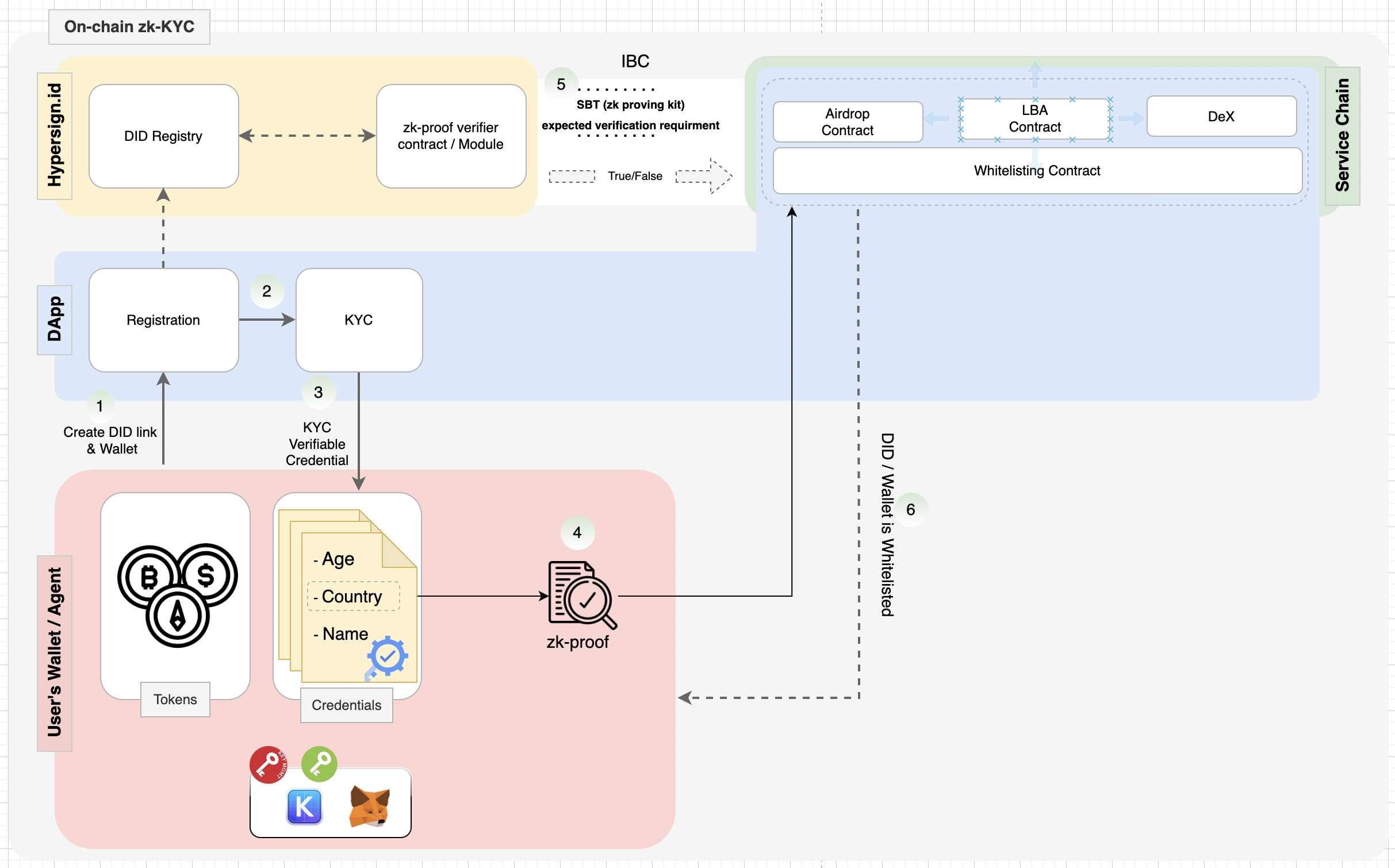
Be wary of vendors promising "complete anonymity" in a KYC context. Regulators require traceability for illicit activity, even if the general user base remains private. The best systems use selective disclosure: they prove you are over 18, from a non-sanctioned country, and not on a watchlist, without revealing your name or address.
When comparing proposals, ask for a demo of the proof generation time during peak load. Also, verify if the vendor retains any raw biometric data. A true ZK-KYC system should never store the original passport image or selfie after verification is complete. If they do, you are not getting zero-knowledge privacy, just encrypted storage.
Choosing the right ZK KYC stack
Deciding on a zero-knowledge KYC architecture requires mapping your compliance obligations against your technical capacity. The market is shifting from centralized databases to decentralized verification, with the global KYC market projected to reach $7.8 billion by 2026. Your choice of infrastructure determines how you handle data sovereignty, regulatory reporting, and user friction.
The decision framework below outlines three primary implementation paths. Each path balances privacy, cost, and integration complexity differently. Choose the step that aligns with your current regulatory burden and engineering resources.
Build and maintain your own zero-knowledge proof circuits. This path offers maximum data sovereignty and customization but requires significant engineering overhead to audit and update cryptographic primitives. Ideal for institutions with dedicated security teams and strict internal data policies.
Use established platforms like Persona or Civic that handle the heavy lifting of verification and proof generation. This reduces time-to-market and shifts compliance liability to the provider. Best for startups and mid-sized firms prioritizing speed and operational simplicity over total data control.

Implement a modular approach using attestation standards like EAS or ZK-TLS. This allows users to carry verified credentials across multiple dApps and platforms. Suitable for ecosystems focused on user ownership and cross-protocol compatibility, though integration complexity is higher.
When evaluating these options, consider the trade-off between privacy and auditability. Self-hosted solutions allow granular control over what data is hashed or revealed, while integrated providers often offer standardized compliance reports. Your decision should hinge on whether your primary constraint is engineering bandwidth or regulatory certainty.
Common Mistakes in ZK KYC Implementation
Zero-knowledge proof systems promise privacy-preserving compliance, but many projects stumble on execution. The gap between theoretical security and operational reality creates significant risks for both platforms and users. Here are three frequent pitfalls to avoid when evaluating or building ZK KYC infrastructure.
Misleading Zero-Knowledge Claims
Not all "ZK" solutions offer true privacy. Some projects use zero-knowledge proofs only for specific steps while storing sensitive data in plaintext elsewhere. Always verify whether the entire verification process is zero-knowledge or if it relies on hybrid models that compromise data protection. A true ZK system should prove compliance without revealing underlying identity data.
Weak Verification Standards
Many implementations accept low-quality proofs that fail under regulatory scrutiny. The KYC market is growing rapidly, with projections reaching USD 7.8 billion by 2026, yet many solutions prioritize speed over auditability. Ensure your ZK proofs meet regulatory standards for non-repudiation and can withstand external verification. Weak proofs create liability rather than solving compliance challenges.
Ignoring Upgrade Paths
ZK cryptography evolves quickly. Solutions that don't plan for algorithmic upgrades become obsolete within years. Post-quantum resistance and circuit optimization are becoming essential requirements. Choose infrastructure that supports modular upgrades without requiring complete system overhauls. Long-term viability depends on architectural flexibility, not just current proof quality.
Zk kyc systems market research: what to check next
Before committing to a zero-knowledge identity stack, teams need to separate marketing hype from regulatory reality. The following answers address the most common objections found in procurement and compliance reviews.
No comments yet. Be the first to share your thoughts!