Why traditional KYC fails in Web3
The standard Know Your Customer model was built for a centralized world. It relies on collecting, storing, and verifying personal data through a central authority. In Web3, this approach creates a fundamental contradiction. Users seek financial sovereignty and privacy, yet traditional compliance demands they surrender their identity to a single point of failure.
This centralized model turns every KYC provider into a high-value target for attackers. When a platform stores sensitive identity documents and biometric data, it creates a data honeypot. If breached, the consequences are not just financial but reputational and legal. For DeFi protocols, this risk is existential. A single leak can destroy trust in an ecosystem built on the promise of user control.
The friction is immense. Traditional KYC processes are slow, often requiring manual reviews and multiple steps. This creates a barrier to entry that contradicts the seamless nature of blockchain transactions. Users are forced to choose between compliance and convenience, leading to drop-offs and a fragmented user experience.
Warning: Centralized KYC databases are prime targets for cyberattacks. The concentration of sensitive personal data undermines the security benefits of decentralized finance.
The solution lies in shifting from data collection to data verification. Zero-knowledge KYC systems allow applications to verify that a user meets compliance requirements without exposing or storing personal data. This approach applies the same cryptographic rigour that underpins the asset layer to the compliance layer, ensuring privacy by design rather than as an afterthought.
How ZK-KYC preserves identity data
Traditional KYC workflows require users to upload sensitive documents—passports, driver’s licenses, and selfies—to centralized servers. This creates a vulnerability for data breaches. ZK-KYC Systems strategy shifts this paradigm by using zero-knowledge proofs to verify specific claims without exposing the underlying personal identifiable information (PII).
Instead of sharing the raw data, the user generates a cryptographic proof that attests to the truth of a statement. For example, a user can prove they are over 18, reside in a permitted jurisdiction, or are not on a sanctions list, without revealing their birthdate, home address, or full legal name. This distinction is fundamental to privacy-first compliance.
The verification workflow
The process relies on a clear separation between the data holder and the verifier, ensuring that no sensitive information traverses the public blockchain.
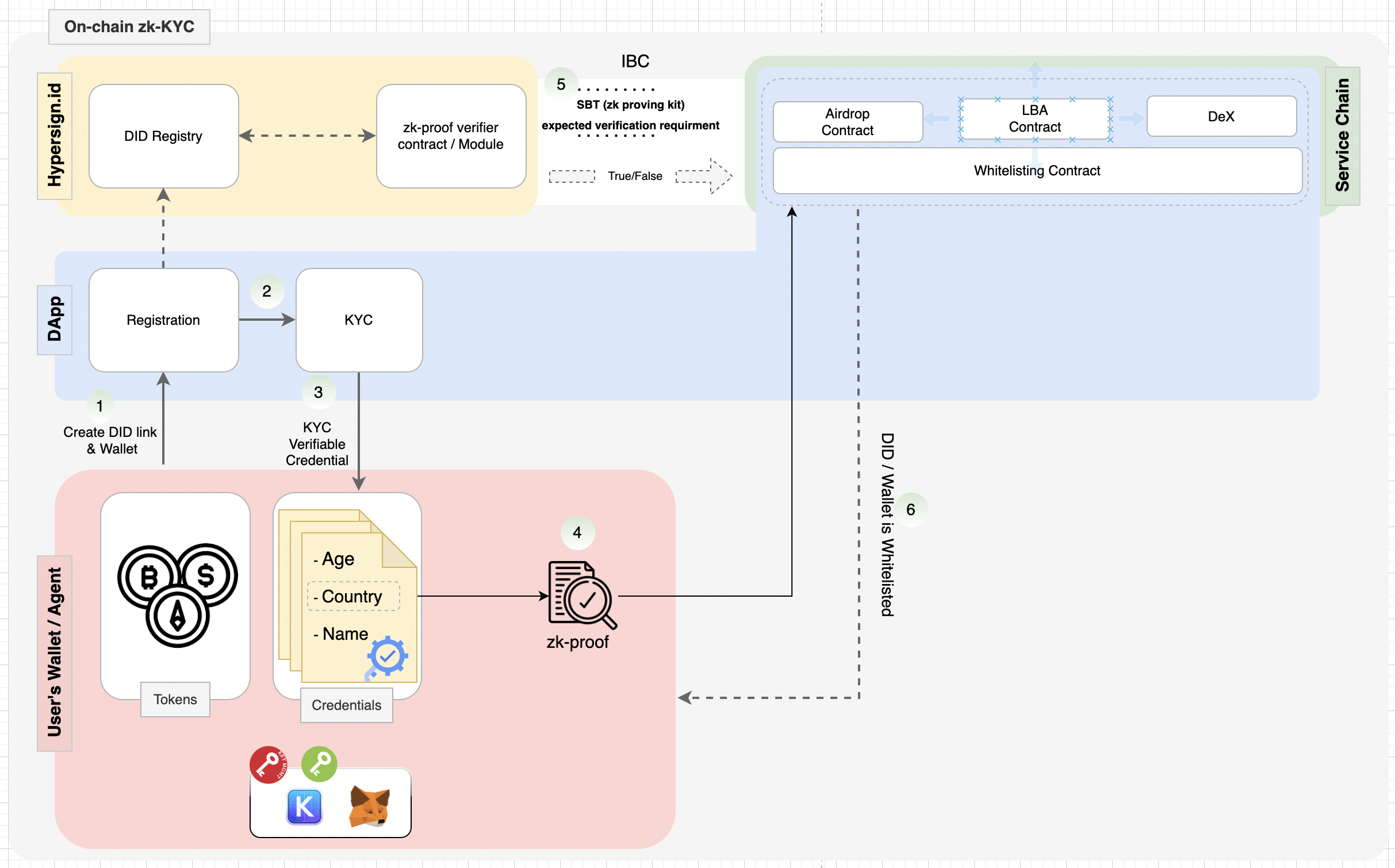
The user interacts with a trusted identity provider (such as a government agency or a certified KYC vendor). The provider verifies the user’s identity off-chain and issues a signed credential or attestation. This credential contains the necessary claims but remains private to the user’s digital wallet or secure enclave.
Using a zero-knowledge circuit, the user’s device combines the private credential with the specific requirements of the service (e.g., "Must be over 18"). The device computes a cryptographic proof that demonstrates the credential satisfies the requirement. Crucially, the proof contains no data about the user; it only contains mathematical evidence that the condition is met.
The generated proof is submitted to a smart contract on the blockchain. The contract verifies the mathematical validity of the proof against the public key of the trusted identity provider. If the proof is valid, the contract mints a non-transferable token (Soulbound Token) or updates a state variable to grant the user access. The underlying PII never enters the transaction.
This mechanism ensures that regulatory transparency is maintained without compromising user privacy. As noted in research on zkKYC in DeFi, this approach requires no personal identifiable information to be shared with protocols for the purpose of regulatory transparency, effectively decoupling compliance from data exposure [src-serp-5].
Why this matters for compliance
The primary advantage of ZK-KYC is data minimization. By design, the system collects only what is strictly necessary for verification. This aligns with regulatory frameworks like GDPR, which mandate that personal data be adequate, relevant, and limited to what is necessary. For legal and regulatory audiences, this reduces liability associated with data storage and potential breaches.
This strategy also prevents function creep. Once a user proves their age or residency, that proof cannot be repurposed to reveal their identity or other attributes. The cryptographic nature of the proof ensures that the verifier gains no additional knowledge beyond the specific claim being validated.
Comparing ZK-KYC providers and models
The ZK KYC Systems strategy relies on selecting infrastructure that balances regulatory rigor with user privacy. Current market offerings differ significantly in how they handle identity issuance, verification latency, and on-chain compatibility. Understanding these distinctions is essential for building compliant, privacy-first applications.
Infrastructure Comparison
The table below outlines key differences between major ZK-KYC infrastructure providers. These metrics reflect typical production capabilities and supported jurisdictions.
| Provider | Verification Latency | Supported Jurisdictions | On-Chain Compatibility |
|---|---|---|---|
| Trezalabs | Sub-second | Global (EU, US, APAC) | EVM, Solana |
| Zyphe | Sub-second | EU, US | EVM |
| Polygon ID | Variable | Global (Self-sovereign) | EVM |
| Civic | Fast | Global | EVM, Multi-chain |
Key Differentiators
Latency and Performance
Sub-second verification is becoming a standard expectation for user-facing applications. Providers like Trezalabs and Zyphe emphasize production-grade speed, ensuring that privacy checks do not introduce friction into the user journey. This is critical for high-volume use cases where compliance cannot slow down transactions.
Jurisdictional Coverage
Not all ZK-KYC systems support the same regulatory frameworks. EU-focused providers may prioritize GDPR compliance, while global platforms often support multiple jurisdictions. For a ZK KYC Systems strategy, choosing a provider with broad jurisdictional support ensures scalability across different markets.
On-Chain Compatibility
Integration with existing blockchain ecosystems is vital. Most modern ZK-KYC providers support EVM-compatible chains, with some extending support to Solana and other multi-chain environments. This flexibility allows developers to deploy verification logic where their users are most active.
Strategic Considerations
When evaluating ZK-KYC Systems strategy options, prioritize providers that offer transparent documentation and official source integration. This ensures that your compliance framework remains robust and auditable. Avoid providers that rely on proprietary, undocumented verification methods, as these can introduce regulatory risk.
For real-time market data on the underlying blockchain networks these systems operate on, refer to the technical chart below.
Integrating ZK-KYC with Smart Contracts
Moving from off-chain identity verification to on-chain enforcement requires careful architectural planning. The goal is to allow a smart contract to trust a user's compliance status without ever seeing their personal data. This integration typically relies on a verification oracle or a dedicated registry contract that acts as the bridge between the ZK-proof and the blockchain state.
1. Deploy a Verification Registry
The foundation of any ZK-KYC system is a smart contract that stores the public verification key. This contract does not store identity data; instead, it holds the parameters needed to validate zero-knowledge proofs. When a user generates a proof that they are KYC-compliant, the smart contract uses this key to verify the proof's validity. If the proof is valid, the contract updates the user's status to "verified" in its internal mapping. This registry serves as the single source of truth for the protocol.
2. Integrate the Oracle Layer
Most ZK-KYC systems use an oracle to fetch the latest verification status. The oracle monitors the verification registry and emits events when a user's status changes. Smart contracts subscribe to these events to stay synchronized. This decoupling ensures that the main application logic remains lightweight and gas-efficient. The oracle acts as a trust-minimized bridge, ensuring that the on-chain state accurately reflects the off-chain verification results.
3. Implement On-Chain Verification Logic
The application smart contract must include a function that accepts a ZK-proof and a public signal (such as a unique user identifier). This function calls the verification registry to check the proof. If the proof is valid and the user is marked as verified, the contract grants access to the protected resource, such as a DeFi position or an airdrop claim. This logic ensures that only compliant users can interact with the protocol, enforcing regulatory requirements automatically.
4. Handle Proof Generation and Submission
Developers must integrate a ZK-circuit into the front-end or a trusted execution environment. The user's identity data is processed locally to generate a proof that they meet specific criteria (e.g., "not on a sanctions list"). This proof is then submitted to the smart contract via a transaction. The contract verifies the proof and updates the user's status. This process ensures that no sensitive data is ever transmitted to the blockchain, preserving user privacy while maintaining compliance.
Pre-Deployment Checklist
-
Verification Key Deployed: Ensure the public key is stored in the registry contract.
-
Oracle Synced: Confirm the oracle is monitoring the registry for status updates.
-
Proof Verification: Test the on-chain verification function with sample proofs.
-
Gas Optimization: Verify that the verification cost is acceptable for your use case.
-
Access Control: Ensure only verified users can access protected functions.
No comments yet. Be the first to share your thoughts!