Why ZK KYC matters for compliance
Zero-Knowledge Proof KYC (ZK-KYC) solves a fundamental infrastructure problem: how to verify regulatory compliance without storing sensitive personal data. Traditional KYC models require institutions to collect, store, and secure raw Personally Identifiable Information (PII). This creates a high-value target for attackers and a significant liability for data breaches. ZK-KYC shifts this paradigm by allowing users to prove they meet specific criteria—such as being over 18, not on a sanctions list, or holding a valid government ID—without revealing the underlying documents or identity details.
The core value proposition is risk reduction through data minimization. When a user generates a zero-knowledge proof, they are essentially showing a cryptographic receipt that says, "I am compliant," rather than handing over their passport or utility bill. This means that even if an institution’s database is compromised, the attacker gains access to meaningless cryptographic hashes rather than usable PII. For legal and compliance teams, this drastically lowers the scope of liability under regulations like GDPR or CCPA, as the organization is no longer a custodian of sensitive personal data.
This approach also streamlines the user journey. Instead of uploading documents to multiple platforms and waiting for manual review, users can generate proofs once and reuse them across different services. This reduces friction for onboarding while ensuring that each service receives a verified, trustless assurance of compliance. By eliminating centralized data hoarding, ZK-KYC aligns technical infrastructure with the legal principle of least privilege, ensuring that only the necessary data is shared to satisfy regulatory requirements.
How ZK KYC infrastructure works
ZK KYC infrastructure operates as a cryptographic relay rather than a traditional database. Instead of storing passports or birth certificates, the system verifies mathematical claims about a user’s identity. This approach allows institutions to confirm that a user meets specific regulatory criteria—such as being a verified adult or a non-sanctioned entity—without ever seeing the underlying personal data.
The process follows a strict three-part flow: credential issuance, proof generation, and on-chain verification. Each step is designed to minimize data exposure while maintaining auditability for regulators.
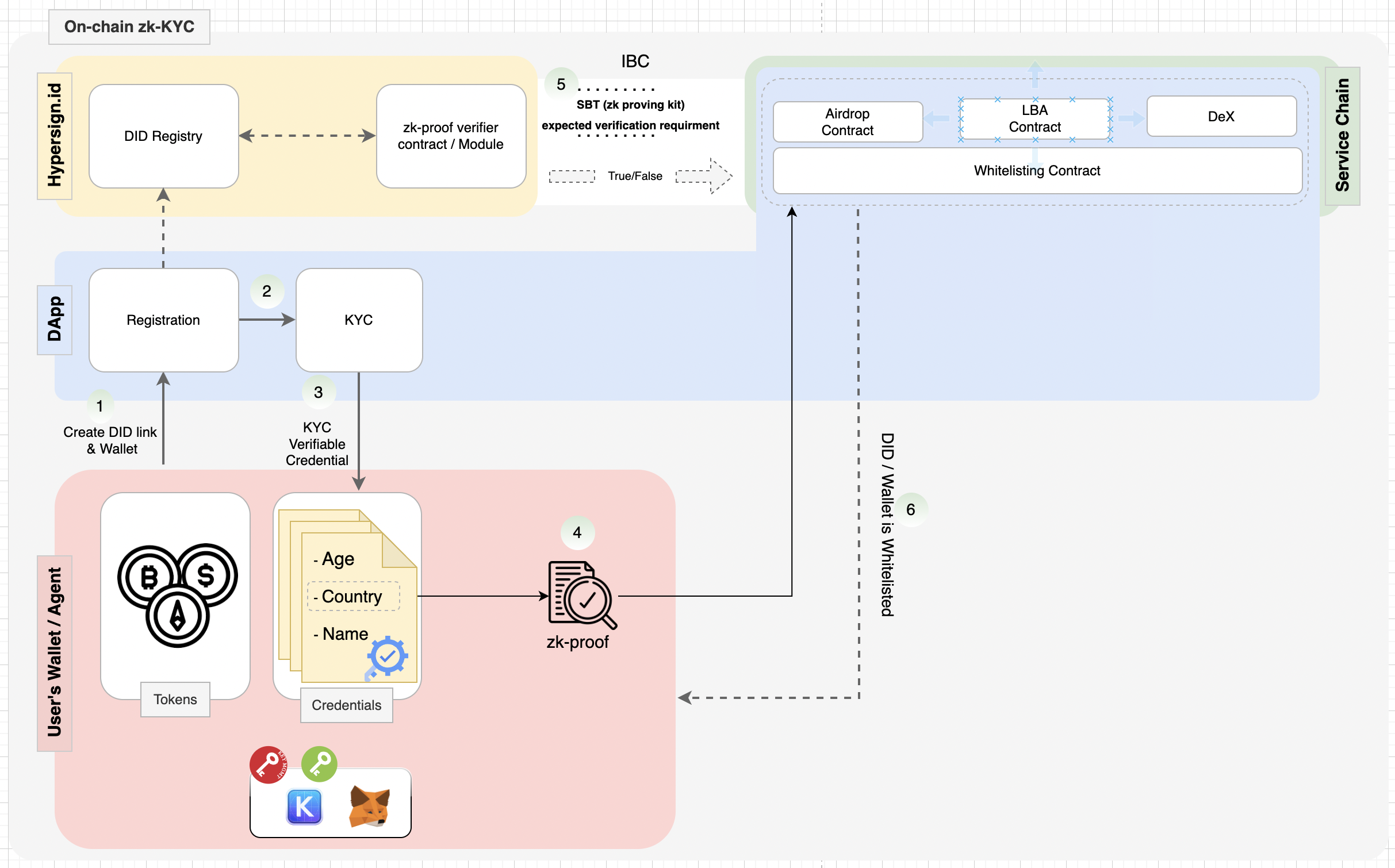
The process begins when a trusted issuer, such as a government agency or a regulated KYC provider, verifies the user’s identity through conventional means. Once verified, the issuer signs a verifiable credential containing specific claims (e.g., "over 18," "jurisdiction: US"). This credential is stored on the user’s device or wallet, not in a central server. The issuer’s public key is recorded on-chain, allowing anyone to validate the signature’s authenticity without accessing the data itself.

When the user wants to interact with a regulated service, their wallet generates a zero-knowledge proof. This cryptographic proof demonstrates that the signed credential in their possession satisfies the required conditions (e.g., "is valid" AND "is from a trusted issuer") without revealing the credential’s contents. The generation happens locally on the user’s device, ensuring that no personal information leaves their control during the verification request.
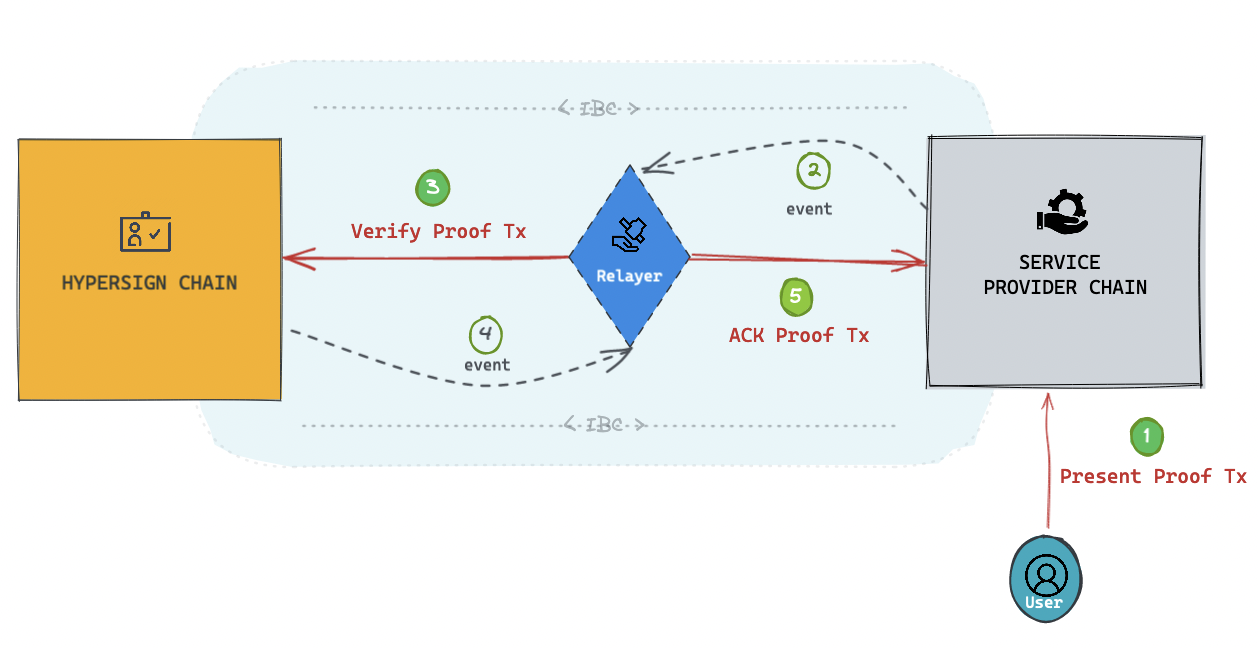
The generated proof is submitted to a smart contract or verification oracle. The contract checks the proof against the issuer’s public key and the defined compliance rules. If the math holds, the contract outputs a simple boolean result: true or false. This result can then grant access to a permissioned pool or trigger a transaction, completing the loop without the protocol ever knowing who the user is.
This infrastructure shifts the burden of privacy from the service provider to the cryptographic protocol. By verifying claims rather than identities, ZK KYC systems enable compliance with regulations like the Travel Rule or AML directives while preserving the anonymity that defines decentralized finance.
Leading ZK KYC tools and providers
The ZK KYC landscape is shifting from experimental proof-of-concepts to production-ready infrastructure. In 2026, the market is dominated by specialized providers that handle the heavy lifting of cryptographic proof generation while ensuring compliance with regional regulatory standards. Choosing the right provider requires looking past privacy marketing claims and examining their actual integration capabilities, document handling policies, and latency profiles.
Several key players have established distinct advantages in this space. Zyphe focuses on regulator-grade verification with sub-second performance, emphasizing that no document retention is required after the initial check. This approach significantly reduces the liability profile for financial institutions. Treza Labs offers a similar infrastructure but frames its value around "cryptographic claims" rather than raw data collection, allowing users to verify specific attributes without exposing underlying PII. zkPass provides a robust framework for verifying identity and compliance data, specifically addressing the high-value target risk that traditional KYC document storage creates.
To help you evaluate these options, the following comparison outlines the core infrastructure differences between the leading providers. These distinctions matter most when you are building systems that need to scale across multiple jurisdictions without compromising user privacy.
| Provider | Privacy Model | Compliance Support | Integration |
|---|---|---|---|
| Zyphe | No document retention | Regulator-grade verification | Sub-second latency |
| Treza Labs | Cryptographic claims only | PII-free verification | Moderate |
| zkPass | Encrypted data verification | Identity & compliance framework | High |
When selecting a provider, consider your specific regulatory environment. If you operate in jurisdictions with strict data sovereignty laws, the "no retention" model offered by providers like Zyphe may be the only viable path. For platforms that need to verify complex user attributes across different chains, zkPass’s encrypted verification framework offers more granular control, albeit with higher integration complexity. Always verify that your chosen provider can generate proofs that are compatible with your existing on-chain or off-chain verification infrastructure.
Strategic implementation for DeFi
Institutional capital remains on the sidelines of decentralized finance primarily because it cannot tolerate the regulatory ambiguity of open, permissionless pools. ZK KYC systems provide the necessary infrastructure to bridge this gap, allowing protocols to verify that liquidity providers are vetted entities without exposing their identities to the broader network. This approach transforms compliance from a friction point into a feature, enabling access to institutional liquidity while maintaining user anonymity.
The integration process begins with credential selection. Protocols must decide which verifiable credentials to accept, such as those issued by accredited KYC providers or regulated financial institutions. These credentials are then linked to a user’s wallet address. Once verified, the user can generate a zero-knowledge proof that attests to their status as a compliant participant. This proof allows them to enter permissioned pools, ensuring that all liquidity providers meet regulatory standards without revealing their personal data to other traders or the public ledger.
Smart contract deployment is the next critical step. The protocol’s smart contracts must be designed to accept and validate these zero-knowledge proofs. This involves integrating zk-SNARK or zk-STARK circuits that can verify the credential’s validity against the protocol’s compliance rules. The contracts should also manage access control, ensuring that only users with valid proofs can interact with specific pools or features. This technical layer ensures that compliance is enforced automatically and transparently.
User onboarding must be seamless to encourage adoption. Protocols should provide clear interfaces that guide users through the verification process, from selecting a KYC provider to generating and submitting their zero-knowledge proof. Documentation should explain the benefits of ZK KYC, such as enhanced privacy and access to higher-yield institutional pools. By reducing friction and providing clear value propositions, protocols can attract both institutional investors and privacy-conscious retail users.
-
Select appropriate verifiable credentials from accredited providers
-
Deploy smart contracts with zk-SNARK/zk-STARK verification circuits
-
Implement user onboarding flows for credential generation and proof submission
-
Configure access control for permissioned liquidity pools
-
Audit compliance logic with legal experts to ensure regulatory alignment
Common questions about ZK KYC
How does ZK KYC work?
Using ZK-KYC, a regulated institution issues a verifiable credential to a user's digital wallet. The user then generates a cryptographic proof of this credential to access permissioned pools, ensuring all participants are vetted entities without exposing their identities to other traders or the public ledger [Chainlink].
Is ZK KYC legally compliant?
Yes, when implemented correctly. ZK KYC satisfies regulatory requirements by proving that specific criteria—such as age, jurisdiction, or accreditation—are met, without revealing the underlying personal data. This aligns with privacy-by-design principles in frameworks like GDPR.
Does ZK KYC replace traditional KYC?
No. ZK KYC is a verification layer, not a replacement for the initial Know Your Customer process. Institutions must still perform traditional identity checks to issue the initial credential. ZK proofs simply allow users to reuse that verified status without re-disclosing sensitive documents repeatedly.
Helpful gear
Use these product recommendations as a starting point, then choose the size, material, and price point that fit how you actually use the gear.

As an Amazon Associate, we may earn from qualifying purchases.
No comments yet. Be the first to share your thoughts!