What makes ZK KYC different
Traditional KYC processes operate on a "trust but verify" model that requires you to trust the verifier with your most sensitive data. When you submit a passport or bank statement to a legacy provider, you are handing over the raw source material. The provider stores this data, creating a high-value target for hackers and a liability under privacy laws like GDPR. As noted by zkPass, this data exposure is the primary weakness of current identity infrastructure, turning every compliance vendor into a potential breach point.
Zero-Knowledge (ZK) KYC flips this dynamic by replacing data storage with data minimization. Instead of sending your actual passport to the verifier, you send a cryptographic proof. This proof confirms that you meet specific compliance predicates—such as being over 18, holding a valid government ID, or not appearing on a sanctions list—without revealing the underlying information. The verifier checks the math, not the document.
This shift changes the legal and operational stakes. You no longer need to worry about whether a third-party KYC provider has retained copies of your documents or suffered a data leak. The verification is complete, the credential is issued, and the raw PII never leaves your device or is stored by the verifier. This is the difference between handing someone your house keys to prove you own a home, and showing them a notarized deed that proves ownership without letting them see inside.
Design the ZK KYC architecture
A functional ZK KYC system relies on three distinct layers working in sequence. The architecture must separate the heavy computation from the on-chain verification to ensure speed and cost-efficiency. This separation is critical for maintaining privacy while satisfying regulatory requirements.
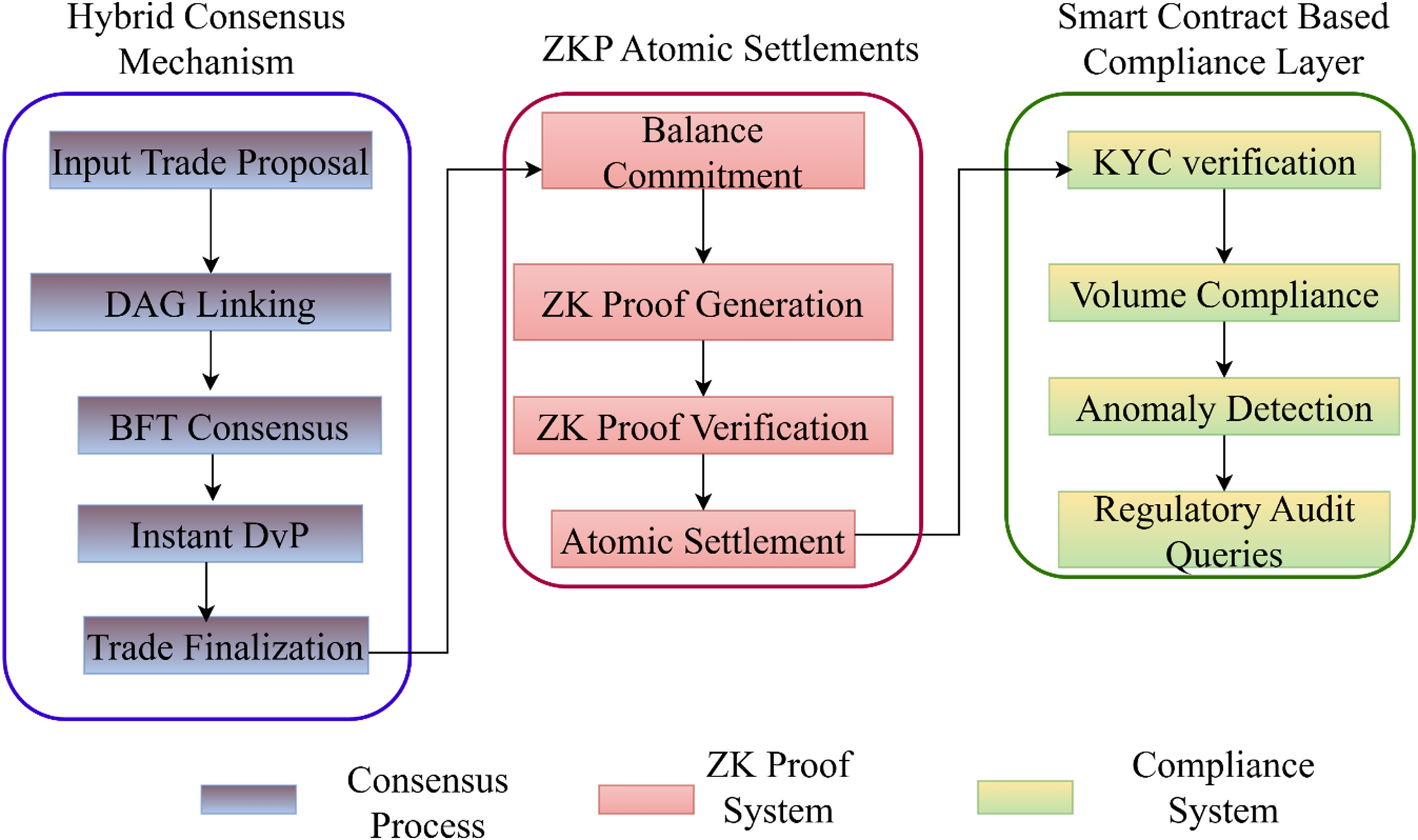
The process begins with a trusted Identity Provider (IdP). After verifying a user's real-world documents, the IdP issues a verifiable credential to the user's wallet. This credential contains the attestation that the user passed KYC checks, but it does not expose the underlying personal data to the broader network. This step ensures that sensitive PII is never stored on-chain or shared with downstream services.
The user's device, acting as the Off-Chain Prover, takes the verifiable credential and generates a zero-knowledge proof. This cryptographic proof demonstrates that the credential is valid and meets specific compliance criteria (e.g., "is over 18" or "is not on a sanctions list") without revealing the actual data points. The computation happens off-chain to avoid high gas fees and preserve user privacy during the generation phase.
The final step occurs on the blockchain. The Verifier Contract receives the proof and the public inputs. It runs a lightweight cryptographic check to confirm the proof is mathematically valid. If the check passes, the contract grants the user access to the permissioned pool or service. This ensures that only verified entities can participate, while keeping the actual identity data hidden from other participants.
This three-layer design prevents the creation of "master keys" that could compromise user privacy. By keeping the heavy lifting off-chain and only verifying the proof on-chain, the system remains scalable and compliant with data protection regulations.
Implement the verification flow
The operational backbone of ZK KYC relies on a precise sequence: credential issuance, proof generation, and on-chain validation. This workflow ensures that compliance checks occur without exposing personal data. Users retain control over their information while institutions satisfy regulatory requirements.
The process begins when a trusted institution issues a verifiable credential to the user’s digital wallet. This credential confirms identity attributes—such as age, jurisdiction, or accreditation—without containing raw personal data. The user stores this credential securely, establishing the foundation for future privacy-preserving interactions.
When accessing a service, the user generates a zero-knowledge proof using their stored credential. This cryptographic proof demonstrates compliance with specific criteria—such as being over 18 or residing in a permitted region—without revealing the underlying identity details. The proof is computed locally, ensuring that sensitive data never leaves the user’s device.
The generated proof is submitted to a smart contract for verification. The contract checks the cryptographic validity of the proof against the issuer’s public key and the defined compliance rules. If the proof is valid, the contract grants access or records the compliance status on-chain. This step finalizes the verification, ensuring that only eligible users interact with the system while maintaining full privacy.
This flow balances regulatory necessity with user privacy. By decoupling identity from verification, ZK KYC systems reduce the risk of large-scale data breaches while meeting strict compliance standards.
Compare ZK KYC Providers
Choosing the right infrastructure provider depends on your specific compliance requirements, technical stack, and privacy guarantees. The following comparison outlines three distinct approaches to zero-knowledge KYC: Zyphe’s regulatory-grade verification, zkPass’s document-integrity focus, and Holonym’s decentralized identity stack.
| Provider | Privacy Model | Integration Complexity | Best For |
|---|---|---|---|
| Zyphe | Sub-second proof generation; no document retention | Standard API; regulated compliance flow | High-volume fintechs needing regulator-grade speed |
| zkPass | Verifies data integrity without exposing raw documents | SDK-based; requires careful credential handling | Platforms needing to verify external data sources |
| Holonym | Full ZK DID stack; user-controlled credentials | Decentralized; requires wallet integration | DeFi protocols and permissioned pools |
Zyphe emphasizes speed and regulatory alignment, offering sub-second verification without retaining user documents. This model suits traditional fintechs that must satisfy strict audit trails while minimizing data liability. zkPass focuses on verifying the integrity of external documents, making it suitable for platforms that need to confirm the authenticity of credentials without storing the underlying files. Holonym provides a full decentralized identity stack, allowing users to generate proofs from any credential. This approach is ideal for DeFi protocols that require permissioned access without exposing user identities to other participants.
Avoid common ZK KYC pitfalls
Building a ZK KYC system is not just a cryptographic exercise; it is a legal and operational one. Many projects fail because they treat privacy as an afterthought or ignore the human element of compliance. To avoid critical mistakes, you must address trusted setup integrity, user experience friction, and regulatory alignment before launch.
1. Weak Trusted Setups and Key Management
The security of your zero-knowledge proofs depends entirely on the trusted setup phase. If the cryptographic parameters (the "toxic waste") are not destroyed securely, a malicious actor could forge proofs without detection. This is not a theoretical risk; it is the foundational weakness of many early ZK implementations. Ensure your setup ceremony is transparent, verifiable, and that no single entity holds the ability to break the system’s integrity. Audit your key management procedures against industry standards like those outlined in the ZK KYC Systems Guide to ensure robustness.
2. Poor User Experience Friction
Even the most secure system fails if users cannot navigate it. ZK KYC introduces complexity that can alienate non-technical users. If the proof generation process is slow, confusing, or requires excessive manual steps, users will abandon the flow. Design for simplicity: abstract away the cryptography. The user should only need to verify their identity once; the system should handle the rest invisibly. Test your UX with real users who have no background in blockchain technology to identify bottlenecks early.
3. Regulatory Misalignment
Privacy-preserving compliance must satisfy regulators, not just cryptographers. A common mistake is building a system that is technically private but legally opaque. Regulators require audit trails and the ability to respond to subpoenas or sanctions lists. Ensure your system supports "revocation" capabilities and can produce evidence of compliance when legally required, without exposing unnecessary user data. Consult with legal experts specializing in financial regulations to ensure your architecture meets current and emerging standards.
Pre-Launch Audit Checklist
Before deploying, verify these critical components to ensure your ZK KYC system is secure, usable, and compliant.
-
Trusted Setup Verification: Confirm that all toxic waste from the setup ceremony has been securely destroyed and that the verification keys are publicly auditable.
-
UX Stress Testing: Test the proof generation flow with non-technical users to ensure it is intuitive and completes within a reasonable time frame.
-
Regulatory Review: Have legal counsel review the system’s ability to handle sanctions screening and regulatory inquiries without compromising core privacy principles.
-
Key Rotation Plan: Establish a clear protocol for rotating verification keys and updating proofs if the underlying cryptographic assumptions change.
-
Fallback Mechanisms: Ensure there is a manual, compliant fallback process for users who cannot generate proofs due to technical limitations.
No comments yet. Be the first to share your thoughts!