What is ZK KYC in practice
Traditional KYC relies on a simple but risky exchange: you hand over your passport, utility bills, and biometric data to a central database, hoping the institution keeps it safe. ZK KYC flips this model. Instead of collecting personal information, the system verifies that you meet specific compliance criteria without ever exposing the underlying data. This approach shifts the burden of proof from data storage to cryptographic verification.
At its core, ZK KYC uses zero-knowledge proofs (ZKPs) to allow a user (the prover) to convince a verifier that a statement is true without revealing any information beyond the validity of the statement itself. In a compliance context, this means you can prove you are over 18, a resident of a specific jurisdiction, or not on a sanctions list, without revealing your actual birth date, home address, or identity documents. As noted by industry analyses, this enables verification without exposure, fundamentally changing how identity predicates are handled in regulated environments [src-serp-4].
The workflow typically involves three steps. First, the user generates a cryptographic proof based on their private data and a set of public rules (e.g., "age > 18"). Second, this proof is submitted to the verifier (the bank or platform). Third, the verifier checks the proof against the public rules. If the proof is valid, access is granted. The verifier learns nothing about the user’s actual data, only that the conditions were met.
This distinction is critical for risk management. By minimizing data collection, organizations reduce their attack surface. If a ZK KYC provider is breached, there is no central repository of passports or IDs to steal. The system verifies identity predicates, not identity documents. This makes ZK KYC a strategic infrastructure choice for institutions aiming to balance strict regulatory adherence with robust user privacy.
How the ZK KYC flow works
Think of a ZK KYC system like a secure vault with a specialized lock. You don't hand the vault keeper your entire passport or financial history. Instead, you prove you have the right key to open it. In technical terms, a user interacts with a trusted issuer—often a regulated entity or a decentralized identity provider—to verify their credentials. Once verified, the system generates a zero-knowledge proof, a cryptographic snippet that confirms compliance without exposing the underlying data.
The architecture relies on three distinct steps. First, the user submits identity data to the issuer. Second, the issuer validates this data against regulatory requirements and issues a credential. Third, the user creates a ZK proof from that credential. This proof asserts a specific claim, such as "the user is over 18" or "the user is not on a sanctions list," without revealing their name, address, or date of birth.
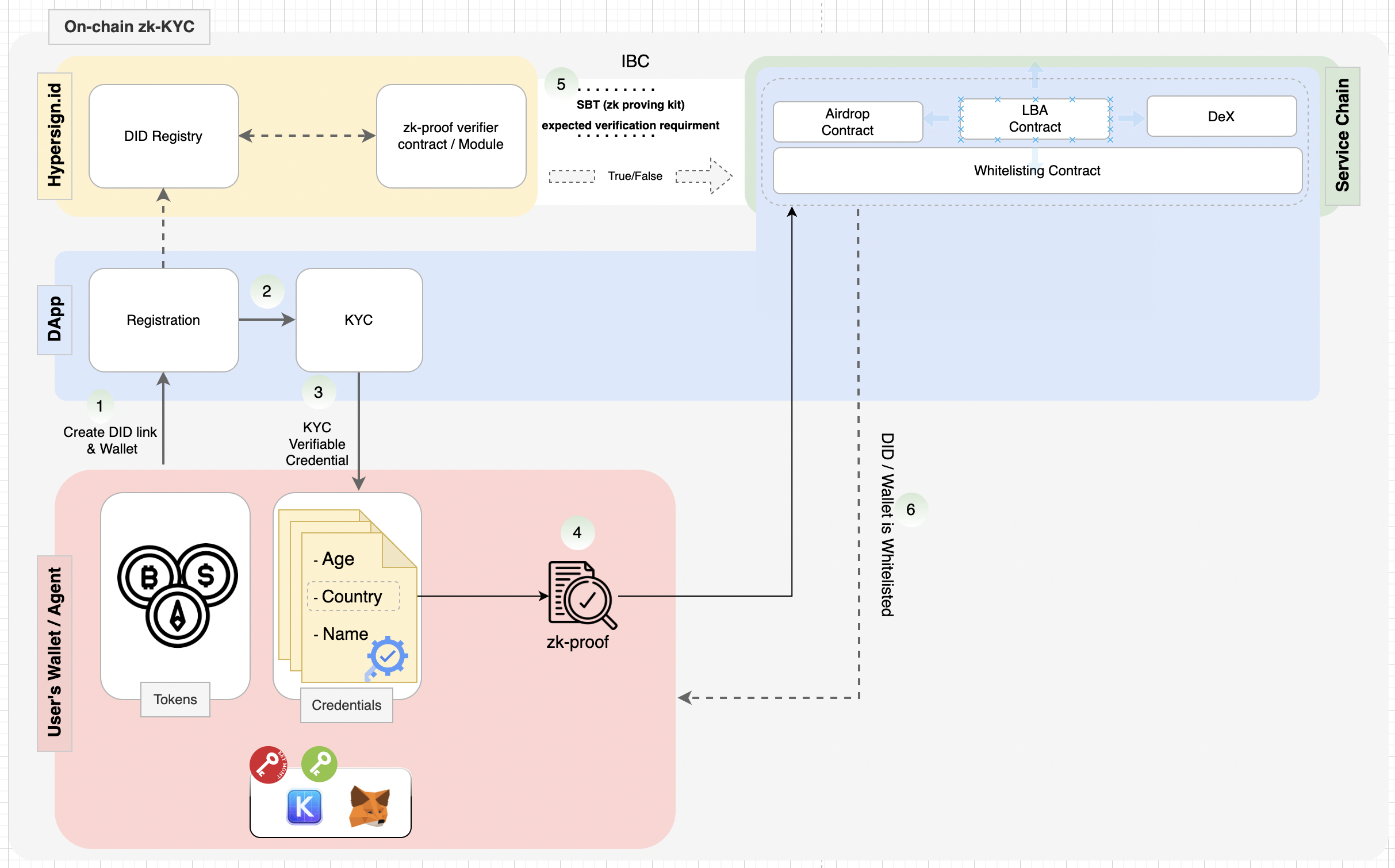
The critical strategic decision lies in the circuit design. A circuit is the set of rules that defines what the proof can verify. If your circuit is too narrow, it won't satisfy the compliance requirements of different jurisdictions. If it's too broad, the computational cost of generating the proof becomes prohibitive for users. You must balance the granularity of the verification with the efficiency of the proof generation.
Verification can happen on-chain or off-chain. On-chain verification is transparent and immutable but expensive in terms of gas fees. Off-chain verification is faster and cheaper but requires a trusted verifier to check the proof. Most robust ZK KYC strategies use a hybrid approach: the proof is generated off-chain and submitted to a lightweight on-chain contract that validates its authenticity. This ensures that the compliance status is publicly verifiable while keeping the user's personal data private.
Choosing the right infrastructure means selecting a circuit that aligns with your specific regulatory needs. For example, a DeFi protocol might only need to verify that a user is not a sanctioned entity, while a traditional finance bridge might require age and residency verification. The goal is to minimize data exposure while maximizing regulatory confidence. This approach reduces the risk of data breaches and simplifies compliance across multiple platforms, as users can reuse their verified status without repeating the KYC process.
For more on how this infrastructure supports regulatory compliance, see the Treza Labs overview on ZK-KYC infrastructure.
Strategic Benefits for DeFi and Banking
Institutions are shifting toward ZK KYC not just for compliance, but for risk management. Traditional KYC processes require storing sensitive personally identifiable information (PII) in centralized databases. This creates a high-value target for attackers. A single breach can expose millions of user records, leading to massive regulatory fines and reputational damage. ZK KYC minimizes this attack surface by verifying identity without storing the underlying data.
Granular compliance is another major driver. Banks and DeFi protocols must adhere to complex, often conflicting, regulations across different jurisdictions. ZK systems allow institutions to prove specific attributes—such as "over 18" or "not on a sanctions list"—without revealing the user's full identity or transaction history. This precision reduces false positives in anti-money laundering (AML) checks and streamlines onboarding. As noted by Studio AM, this approach offers a new paradigm for balancing regulatory requirements with user privacy in decentralized finance [[src-serp-1]].
User trust is the final pillar. Customers are increasingly aware of data privacy risks. By adopting privacy-preserving compliance, financial institutions signal that they value user security alongside regulatory adherence. This transparency can improve adoption rates, particularly among crypto-native users who prioritize self-custody and data sovereignty. zkMe’s fully decentralized solution highlights this shift, emphasizing that verification can be secure and private without exposing sensitive data [[src-serp-7]].
The emerging ZK KYC landscape
The market for zero-knowledge KYC infrastructure is still taking shape, distinct from the mature traditional compliance vendors. While established players like Sumsub, Veriff, and Jumio dominate the current space by collecting and storing vast amounts of personal identifiable information (PII), a new wave of providers is building systems that verify claims without holding the underlying data. This shift addresses a critical inefficiency: users currently repeat the same KYC processes across multiple platforms, while enterprises bear duplicated compliance costs and storage liabilities.
Traditional KYC acts like a centralized database where every platform keeps its own copy of your passport. ZK KYC changes this by allowing a user to prove they are over 18 or a resident of a specific region without revealing their birthdate or address. The infrastructure is still emerging, with providers like Treza Labs and zkMe focusing on cryptographic proofs that can be verified on-chain or in off-chain systems without exposing sensitive user data.
The following comparison highlights the structural differences between legacy compliance vendors and these new privacy-first ZK-native solutions.
| Vendor Type | Data Storage | Privacy Model | Integration Complexity |
|---|---|---|---|
| Traditional (e.g., Sumsub) | Centralized PII databases | Full data exposure to vendor | Standard API/SDK |
| ZK-Native (e.g., Treza) | Zero PII storage | Cryptographic proof only | Complex circuit design |
| ZK-Native (e.g., zkMe) | Decentralized proofs | Privacy-first verification | Decentralized identity layers |
Navigating the Regulatory Landscape
Zero-knowledge KYC is no longer just a theoretical privacy tool; it is becoming a structural necessity for compliant decentralized finance. As regulators tighten their grip on digital assets, ZK systems offer a way to satisfy strict identity requirements without exposing sensitive user data to public ledgers or centralized databases.
The European Union’s eIDAS 2 regulation is a primary driver for this shift. The proposed framework introduces Digital Identity Wallets and aims to create a unified digital identity standard across member states. Research into frameworks like ZK-KYC-DSIG suggests that zero-knowledge proofs can effectively bridge the gap between these new digital credentials and blockchain verification, allowing users to prove their identity status without revealing the underlying personal information.
This alignment is critical for addressing "lawful intercept" requirements. Financial institutions and exchanges must monitor for illicit activity, but traditional KYC processes often dump all user data into a single point of failure. ZK systems allow for selective disclosure, enabling compliance teams to verify that a user is not on a sanctions list or meets age requirements without seeing their full name, address, or government ID. This approach reduces liability and builds trust with regulators who are increasingly wary of data breaches.
Mainstream adoption depends on this regulatory clarity. As laws like the EU’s AMLA (Anti-Money Laundering Act) evolve, the industry is moving toward infrastructure that is both privacy-preserving and audit-ready. ZK KYC provides the technical foundation for this balance, ensuring that compliance is a feature of the protocol rather than an afterthought.
Common questions about ZK KYC
Users often ask how ZK systems differ from traditional identity checks. At its core, zero-knowledge refers to a cryptographic technique that enables one party to convince another they possess certain information without revealing the actual data itself. This allows operators to confirm a customer is over 18, EU-resident, and sanctions-clear without ever receiving their passport or address details.
A frequent concern is whether ZK KYC replaces existing providers. It does not. Top KYC companies like Sumsub, Veriff, and Trulioo remain essential for initial data collection. ZK proofs simply add a privacy layer on top of their verification results, ensuring that the sensitive data never leaves the user's control during the final compliance check.
Helpful gear
Use these product recommendations as a starting point, then choose the size, material, and price point that fit how you actually use the gear.


As an Amazon Associate, we may earn from qualifying purchases.
No comments yet. Be the first to share your thoughts!