Why ZK KYC Matters for Compliance
Traditional KYC workflows treat user data as an asset to be hoarded. Service providers collect passports, bank statements, and proof of residence, storing them in centralized databases that become high-value targets for cyberattacks. This model creates a paradox: to prove you are who you say you are, you must surrender the very privacy you are trying to protect.
Zero-Knowledge Proof KYC (ZK-KYC) flips this dynamic. Instead of sharing raw documents, a user generates a cryptographic proof that they meet specific regulatory criteria—such as being over 18, not on a sanctions list, or holding a valid license—without revealing the underlying data. The verifier checks the proof’s validity without ever seeing the personal information itself.
This shift moves compliance from data hoarding to data minimization. By eliminating centralized PII storage, ZK-KYC reduces the attack surface for breaches while maintaining rigorous regulatory standards.
For institutions, this means satisfying auditors and regulators without managing the liability of storing sensitive identity records. For users, it means participating in regulated financial activities without exposing their entire identity history to every platform they join. The technology aligns privacy preservation with legal necessity, turning compliance from a data burden into a verifiable, privacy-first transaction.
The Proof Generation Flow
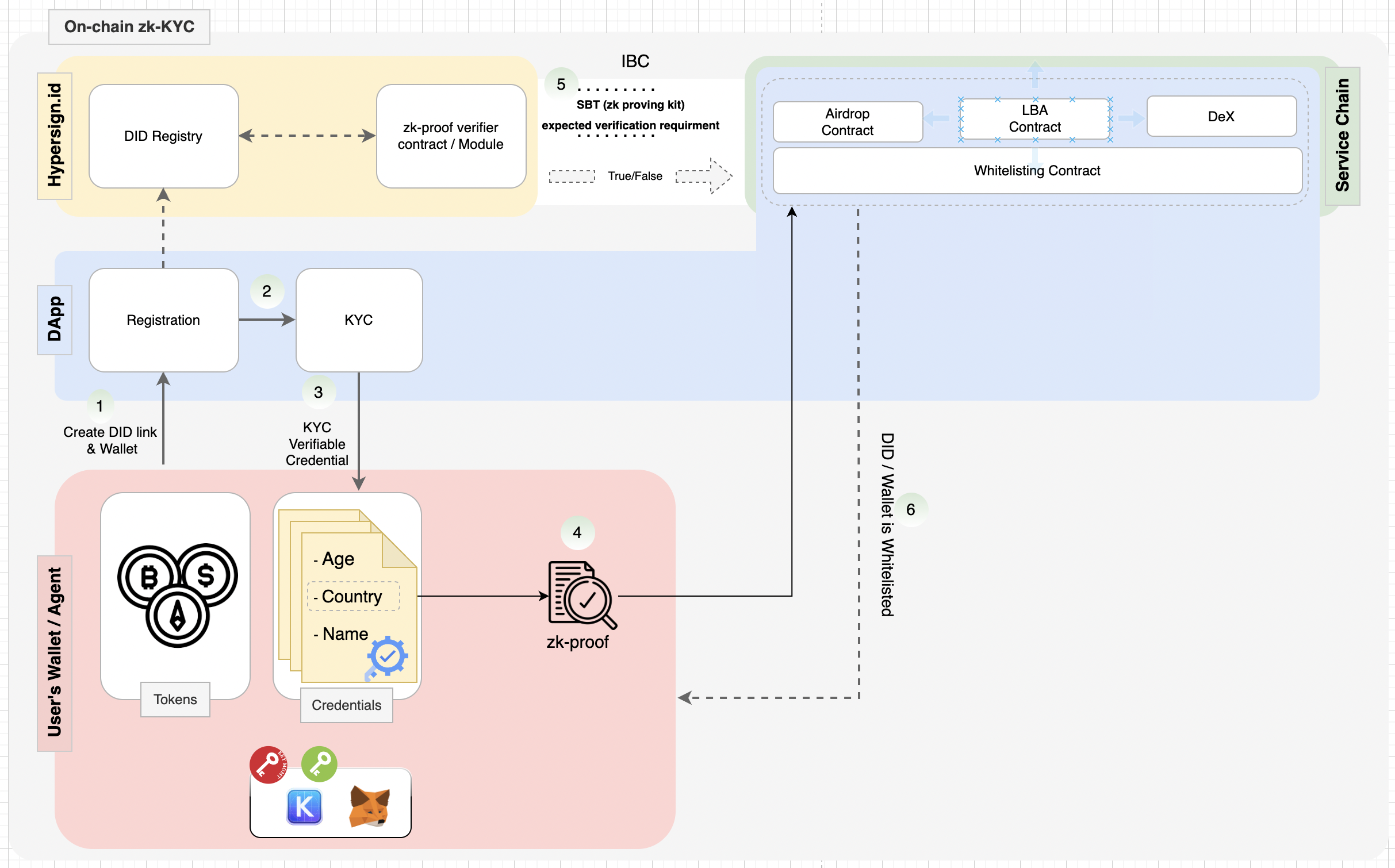
Zero-knowledge KYC (ZK KYC) infrastructure operates by separating identity issuance from identity verification. The process begins when a trusted institution—such as a bank or government agency—issues a verifiable credential to a user’s digital wallet. This credential contains encrypted personal data, ensuring the raw information never leaves the user’s device. Instead of sharing a passport scan or social security number, the user holds a cryptographic token that proves they meet specific conditions, such as residing in a permitted jurisdiction.
When the user needs to access a service, they generate a zero-knowledge proof. This mathematical artifact confirms that the data in their wallet satisfies the required conditions without revealing the underlying details. For example, a proof can demonstrate that a user is on a compliance whitelist without exposing their name or transaction history to other participants in the network. This mechanism allows permissioned pools, such as regulated DeFi platforms, to verify that all liquidity providers are vetted entities while maintaining strict privacy.
The verification stage occurs on-chain or via a dedicated oracle layer. Smart contracts validate the zero-knowledge proof against a set of public parameters. If the proof is mathematically sound, the contract grants access or executes the transaction. This on-chain validation ensures that the compliance check is transparent and immutable, yet the actual identity data remains hidden. The system effectively decouples regulatory compliance from data exposure, allowing institutions to meet legal obligations without becoming custodians of sensitive personal information.
ZK KYC Providers and Infrastructure
The landscape of zero-knowledge KYC is shifting from experimental prototypes to production-grade infrastructure. Providers are now distinguishing themselves not just by the math they use, but by how they handle the "last mile" of user onboarding and the specific regulatory predicates they support. Understanding these architectural differences is essential for institutions selecting a compliance stack.
| Provider | Core Focus | Supported Predicates | Integration Model |
|---|---|---|---|
| Treza Labs | Infrastructure & SDKs | Age, Citizenship, Sanctions | Developer SDKs & API |
| zkPass | User-Centric Verification | Income, Employment, Assets | Browser Extension & Mobile |
| Studio AM | DeFi Compliance | Whitelist, AML Status | Smart Contract Modules |
| Boundless | L1 Integration | Native ZK Verification | Chain-Level Protocol |
Treza Labs operates primarily as an infrastructure layer, providing the cryptographic primitives that other applications can embed. Their approach minimizes data collection by verifying claims—such as citizenship or sanctions status—without storing the underlying identity documents. This "verify without storing" model significantly reduces the attack surface for data breaches, a primary concern for regulated entities.
In contrast, zkPass focuses on the user experience by allowing individuals to verify off-chain data sources, such as bank statements or employment records, directly into their wallets. This is particularly useful for DeFi lending protocols that require proof of income or asset liquidity without exposing the full financial history to the protocol. The verification happens off-chain, and only the zero-knowledge proof is submitted to the blockchain.
For blockchain-native compliance, providers like Boundless are integrating ZK verification directly into the ledger layer. The XRP Ledger, for example, recently added native support for ZK proof verification through Boundless. This allows for on-chain compliance checks that are executed at the protocol level, reducing the need for external oracles or complex smart contract logic to validate user status.
Regulatory shifts are forcing a move to zero-knowledge KYC
New regulations are no longer just suggestions; they are infrastructure requirements. The European Union’s eIDAS 2 regulation and the US Anti-Money Laundering Act (AMLA) are tightening the rules on how institutions verify customer identities. For financial and legal sectors, the old model of storing raw personal data in centralized databases is becoming a liability. These laws demand higher standards for data protection and auditability, creating a direct need for systems that can prove compliance without exposing the underlying data.
Zero-knowledge proofs (ZKP) offer a technical solution to this legal pressure. Instead of sharing a full digital ID, a user can generate a cryptographic proof that they meet specific conditions—such as being over 18 or located in a permitted jurisdiction. This allows institutions to satisfy eIDAS 2’s strict privacy mandates while maintaining the robust audit trails required by AMLA. The result is a system where verification is mathematically guaranteed, not just administratively checked.
Adoption is already visible in the market. The integration of ZK proofs into major ledgers, such as the XRP Ledger’s partnership with Boundless, signals that infrastructure providers are preparing for this regulatory shift. As compliance costs rise, organizations are turning to ZK-based verification to reduce the risk of data breaches while meeting the rigorous demands of global regulators.
Scaling ZK Proving Without Breaking the Bank
Zero-knowledge proofs are computationally heavy. Generating proofs, especially with zk-SNARKs, demands significant CPU and memory resources. As user bases grow, this computational complexity can slow down transaction processing and drive up operational costs. This is the primary bottleneck for scaling ZK KYC systems.
To mitigate this, infrastructure must shift from single-node proving to distributed proving networks. By parallelizing proof generation across multiple nodes, you can maintain throughput without linearly increasing costs. This approach turns a sequential bottleneck into a scalable pipeline.
Another critical fix is optimizing the proof system itself. Transitioning to zk-STARKs or Halo2 can reduce the computational overhead, as these systems often require less trusted setup and are more efficient on modern hardware. However, this requires careful integration with existing compliance workflows to ensure the proofs remain verifiable and legally sound.
No comments yet. Be the first to share your thoughts!