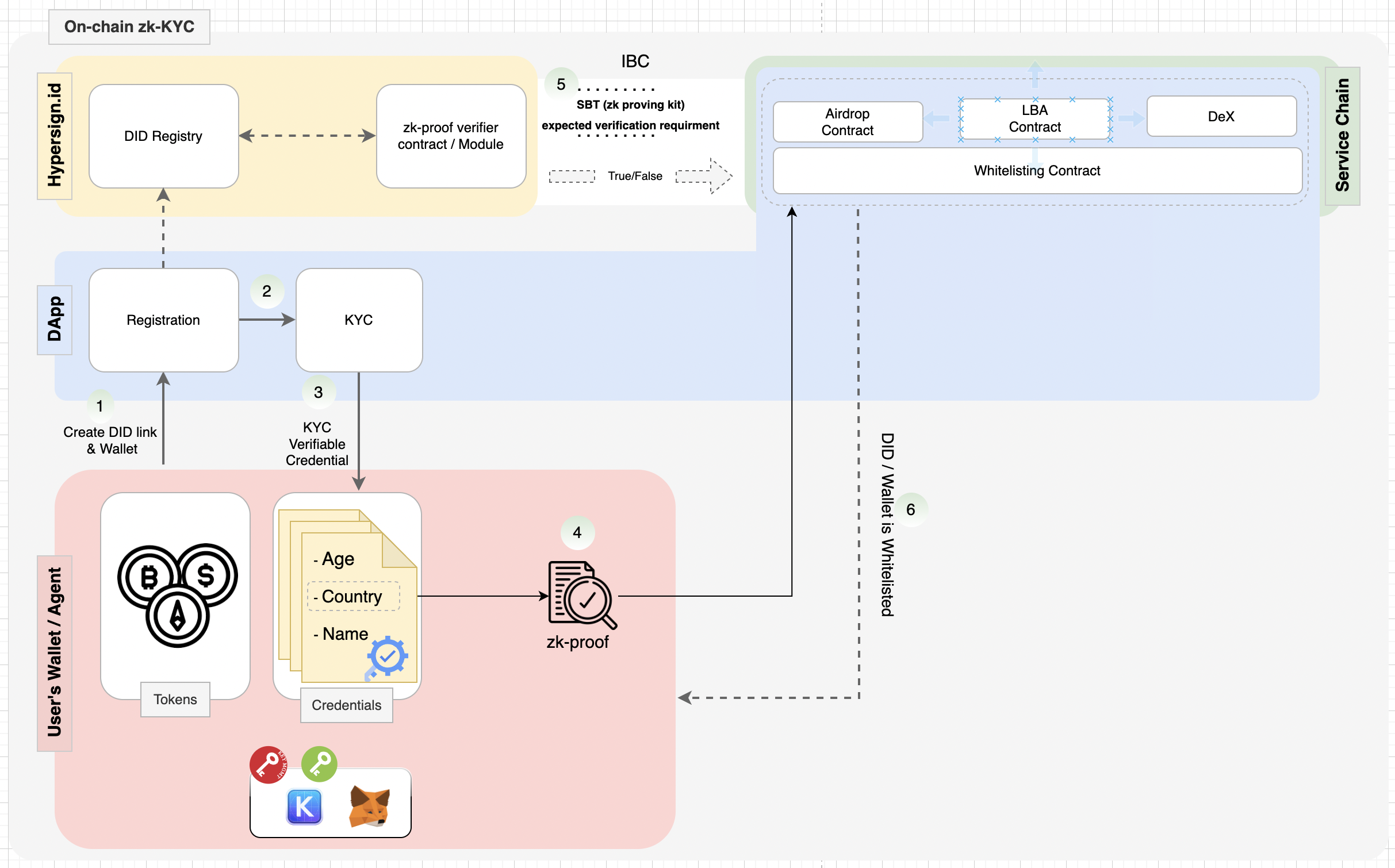
How zk KYC systems actually work
Traditional KYC relies on data storage. You submit your passport, a centralized server saves it, and later, another institution asks for it again. This creates a massive, attractive target for hackers and forces users to repeatedly share sensitive documents they cannot control.
Zero-Knowledge KYC (zk KYC) flips this model. Instead of storing your data, institutions issue a verifiable credential to your digital wallet after verifying your identity once. This credential is a digital token that proves you passed the check, without containing the actual passport image or personal details.
When you need to access a regulated service, you generate a zero-knowledge proof. This is a cryptographic method that allows you to prove a statement is true without revealing the underlying data. For example, you can prove you are over 18 without revealing your birth date. The receiving system verifies the proof mathematically. If the math checks out, access is granted. The verifier never sees your identity, and no sensitive data is shared or stored by the receiving party.
This shift from data storage to data verification is the core value proposition of zk KYC. It reduces liability for institutions and restores privacy control to users. The process is fast, often taking less than a second, and eliminates the need for redundant document uploads.
The infrastructure typically involves three parties:
- The Issuer: The regulated entity (like a bank or exchange) that verifies your identity and issues the credential.
- The User: You, who hold the credential in your digital wallet and generate the proof.
- The Verifier: The new service you are trying to access, which checks the proof without seeing your raw data.
While the computational complexity of some ZK protocols can be high, modern implementations like zk-SNARKs are optimized for speed. This allows for real-time verification, making the technology viable for high-frequency trading platforms and regulated DeFi applications where compliance is mandatory but privacy is expected.
Infrastructure Layers for Privacy-Preserving KYC
Building a functional zero-knowledge KYC (ZK KYC) system requires stitching together several distinct technical layers. Unlike traditional compliance tools that rely on centralized databases, this stack prioritizes cryptographic verification over data storage. The architecture generally follows a linear flow: credential issuance, proof generation, and on-chain validation.
Zero-Knowledge Circuits
At the core of the system are zero-knowledge circuits—specific programs that define the rules for what constitutes a valid identity. These circuits encode the logic required to verify attributes (e.g., age > 18, jurisdiction = approved) without revealing the underlying personal data. Developers typically use frameworks like Circom or Halo2 to write these circuits. When a user submits their data, the circuit processes it to create a cryptographic proof. This proof is computationally expensive to generate but fast to verify, ensuring that the system remains scalable even as user bases grow.
Oracles and Off-Chain Verification
Since blockchains cannot directly process sensitive identity documents, off-chain oracles bridge the gap. Trusted identity providers (such as government agencies or certified KYC vendors) verify the user’s documents off-chain and issue a signed credential. This credential is then passed to the ZK circuit. The oracle’s role is to ensure that the input data fed into the circuit is authentic and untampered. This step is critical for regulatory compliance, as it anchors the digital proof to a legally recognized identity source.
On-Chain Verification
The final layer involves smart contracts that store the verification logic and accept proofs. Once a user generates a ZK proof off-chain, they submit it to the on-chain verifier contract. The contract checks the mathematical validity of the proof against the public parameters. If the proof is valid, the contract emits an event or updates a state variable (such as a whitelist or badge) indicating that the user is verified. This allows dApps to programmatically grant access to permissioned pools or features without ever seeing the user’s private identity details.
Market Context
The infrastructure costs for ZK KYC are closely tied to the gas fees and computational resources required to generate and verify proofs. While the technology is mature, the economic viability often depends on the underlying blockchain’s efficiency. The following chart illustrates recent market volatility in privacy-focused identity tokens, which can impact the cost structure of deploying these systems.
Compliance strategy for institutional DeFi
Institutional adoption of decentralized finance hinges on one friction point: regulatory compliance without operational collapse. Traditional KYC requires centralized data hoarding, creating single points of failure that attract hackers and invite regulatory scrutiny. ZK KYC changes the equation by allowing institutions to verify compliance status without ever seeing the underlying personal data.
The mechanism is straightforward. An authorized entity issues a verifiable credential to a user’s wallet. The user then generates a zero-knowledge proof that confirms they meet specific criteria—such as being over 18 or passing an AML check—without revealing their identity to the protocol or other participants. This satisfies AML/KYC requirements while maintaining the privacy that institutional clients demand.
| Feature | Traditional KYC | ZK KYC |
|---|---|---|
| Data Storage | Centralized repository | Decentralized credential |
| Privacy Level | Zero (full data exposure) | High (minimal data exposure) |
| Breach Risk | High | Minimal |
| Verification | Manual or database lookup | Cryptographic proof |
This shift reduces the attack surface for institutions. By storing only cryptographic proofs rather than sensitive personally identifiable information (PII), organizations mitigate the catastrophic risk of data breaches. For legal and compliance teams, this means meeting regulatory obligations while drastically lowering liability. The infrastructure supports this by ensuring that only the minimum necessary predicates are verified, aligning with data minimization principles embedded in modern privacy laws.
Market Adoption and Infrastructure Reality
The transition from pilot programs to production infrastructure for ZK KYC is accelerating in 2026. Financial institutions are no longer debating the theoretical privacy benefits; they are implementing zero-knowledge proofs to meet regulator-grade verification standards without retaining sensitive user documents. This shift is driven by the need to balance strict compliance requirements with the operational reality of sub-second verification performance.
Current market leaders are focusing on reducing the computational overhead that previously hindered scalability. While early ZK-SNARK implementations required significant processing power, newer protocols are optimizing proof generation to handle higher user volumes. This efficiency allows institutions to issue verifiable credentials to user wallets, enabling participants to prove their vetted status in permissioned pools without exposing their full identity to other network actors.
Despite these advances, the infrastructure remains resource-intensive. The computational complexity of generating zero-knowledge proofs continues to impact transaction processing speeds and costs as user bases expand. Institutions must weigh these technical constraints against the privacy risks of traditional KYC models, where full identity disclosure is often unnecessary yet still practiced. The market is currently consolidating around solutions that offer a pragmatic balance between cryptographic security and practical throughput.
Implementation Challenges and Trade-offs
Building ZK-KYC systems requires balancing privacy with regulatory compliance, a process that introduces significant computational complexity. Unlike traditional databases, zero-knowledge protocols demand heavy cryptographic operations to generate proofs, which can strain infrastructure as user bases expand.
The scalability of these systems is often the primary bottleneck. Protocols like zk-SNARKs, while offering compact proof sizes, require substantial computational resources during the proving phase. This overhead can slow transaction processing and increase operational costs, particularly when verifying high volumes of KYC checks concurrently.
Designing circuits that avoid "master keys" while maintaining strict compliance is another hurdle. If the system architecture is flawed, it may inadvertently create central points of failure or expose sensitive data, undermining the core promise of privacy-preserving compliance. Organizations must carefully evaluate these trade-offs before committing to specific ZK architectures.
Frequently asked questions about ZK KYC
How does zk KYC work?
Zero-knowledge KYC (ZK-KYC) shifts verification from exposing raw data to proving eligibility. An institution issues a verifiable credential to a user’s wallet after checking their identity. The user then generates a cryptographic proof that they meet specific criteria—such as being a vetted entity—without revealing their actual identity or personal details to other participants in the network chain.link.
What are the disadvantages of using ZKP?
The primary bottleneck for ZK-KYC is computational complexity. Generating zero-knowledge proofs requires significant processing power, which can slow down transaction speeds and increase operational costs as user bases scale. Additionally, the current ecosystem lacks standardized protocols, making it difficult for different platforms to interoperate seamlessly without custom integration work.
Can ZK KYC replace traditional identity verification?
Not entirely. ZK-KYC is best viewed as a privacy layer on top of existing compliance frameworks rather than a replacement. Regulators still require a trusted third party to perform the initial "Know Your Customer" checks. ZK proofs then allow users to interact with decentralized applications or financial services while keeping their sensitive data hidden from public view.
Is ZK KYC compliant with GDPR and AML laws?
Yes, when implemented correctly. ZK-KYC aligns with the "privacy by design" principles of GDPR by minimizing data exposure. For Anti-Money Laundering (AML) compliance, the system ensures that only verified entities can participate, satisfying regulatory requirements for vetting while protecting user anonymity from peers. However, institutions must still maintain records of the initial identity checks for audit purposes.
No comments yet. Be the first to share your thoughts!